
biodiversity
Panoramic view of the village
From “La Volta des General”, visitors can enjoy a panoramic view of the village. The terraced fields, arranged in stepped levels, create a distinctive landscape and support both cultivated land and areas of Mediterranean scrubland. The village lies between the mountains and the sea, where two different habitats meet. The surrounding vegetation is mainly composed of pine forests and stands of Mauritanian grass.
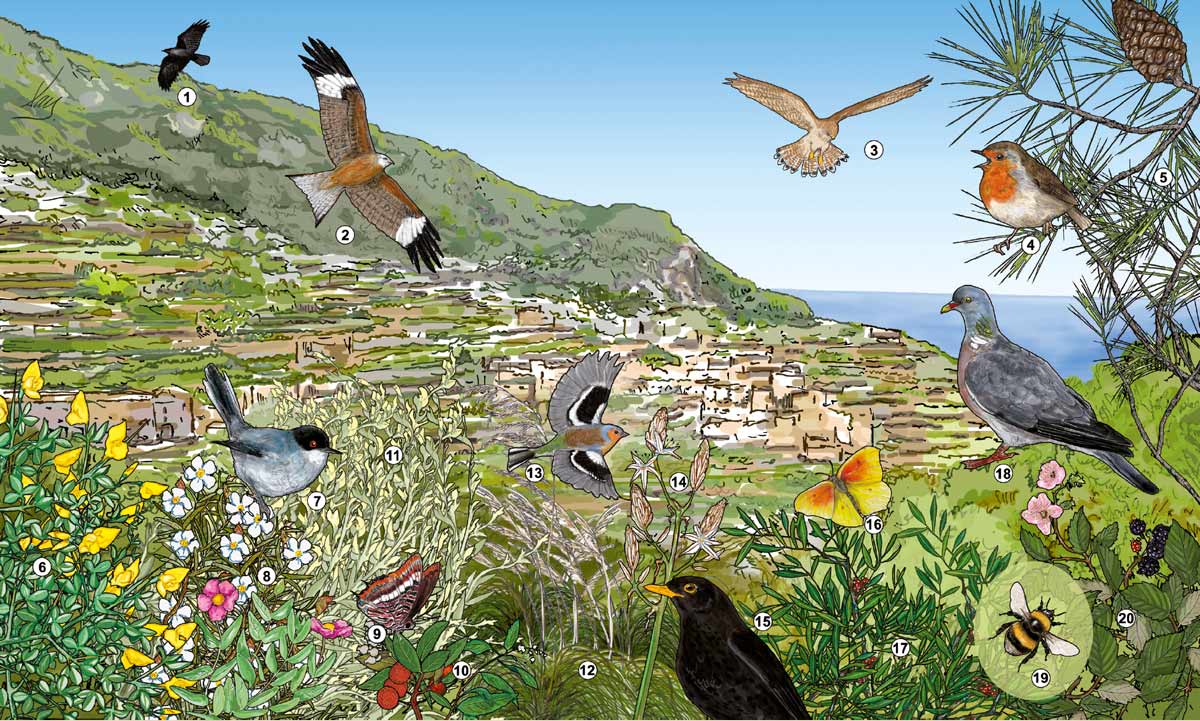
1. Corvus corax
Northern Raven. Glossy black in colour, with distinctive fingered wingtips, the raven can be heard uttering its characteristic croaks. It performs aerial acrobatics. It is a scavenger and an opportunistic feeder. It breeds on cliffs. It mates for life.
2. Milvus milvus
Red Kite. A bird of prey easily identified by its forked tail and a large white patch beneath each wing. It soars while scanning the territory in search of food. It nests in trees.
3. Falco tinnunculus
Common Kestrel. The male has a grey head and tail, while the female is entirely orange-brown with black markings. It feeds on insects, mice, geckos and small birds. It often remains suspended in the air in a characteristic posture with its tail spread like a fan.
4. Erithacus rubecula
European Robin. A small, highly territorial bird that arrives in autumn and leaves in spring. A large orange patch covering the face and breast stands out. It produces a melodious song. It moves by means of short flights and small hops. It feeds on insects, spiders and also on fruits.
5. Pinus halepensis
Aleppo Pine. A tree typical of the Mediterranean. It forms forests, known as pinewoods, which are very important for soil protection.
6. Calicotome spinosa
Spiny Broom. A shrub with small stalked leaves. It has long spines. In spring, its intense yellow flowering stands out in woodland areas and Mediterranean scrubland. The fruit is a flat pod resembling a small carob.
7. Curruca melanocephala
Sardinian Warbler. The male’s coloration is more contrasting, being grey with a white throat and a black upper head. Its red eyelids stand out. It is a small, elusive bird that moves through the vegetation. It feeds on insects and small fruits.
8. Cistus monspeliensis / Cistus albidus
Rockroses. The two common species are the Narrow-leaved Cistus, which has narrow green leaves, and the Grey-leaved Cistus, which has broad greyish leaves. Despite their names, the latter has pink flowers while the former has white flowers. They are typical of Mediterranean scrubland and woodland undergrowth.
9. Charaxes jasius
Two-tailed Pasha. A large butterfly with a fast flight. The upper side is brown with orange-edged margins, while the underside of the wings displays a very attractive and complex pattern. It feeds on the juices of ripe fruits. The caterpillar lives camouflaged on strawberry tree leaves, on which it feeds. The female lays a single egg on each leaf.
10. Arbutus unedo
Strawberry Tree. A shrub typical of Mediterranean scrubland and woodland areas. In autumn, its fleshy red fruits coincide with its greenish-white flowering. The branches are reddish and the leaves are broad with serrated margins.
11. Anthyllis cytisoides
Mediterranean Kidney Vetch. A shrub characterised by its greyish-green colour and yellow flowering in the form of a long spike. It can form dense masses along roadsides. It is normally associated with pinewoods.
12. Ampelodesmos mauritanicus
Mauritanian Grass. A large grass with very long, narrow leaves that forms the communities known locally as carritxeres. It grows after forest fires and protects the soil from erosion. Its flowering stems can exceed one metre in height.
13. Fringilla coelebs
Common Chaffinch. A bird typical of woodland and rural areas. The male’s coloration is more intense. In winter, individuals arrive from northern Europe. It is a seed-eating species and partly omnivorous. The male’s song is strong and distinctive.
14. Asphodelus ramosus
Branched Asphodel. It grows in all types of terrain, especially Mediterranean scrubland, roadsides and woodland. The leaves are long and flat. At the beginning of spring it produces a long, thick stem with flowers at the upper part.
15. Turdus merula
Common Blackbird. A bird commonly found in woodland, orchards and gardens. The male is black with a yellow or orange bill and eye-rings. The female is dark grey with brownish tones. It makes short, low flights. In spring the male produces a melodious song.
16. Gonepteryx cleopatra
Cleopatra Butterfly. The male is bright yellow, while the female is a very pale lemon colour, almost white. It flies during the sunniest hours of the day. When at rest, it keeps its wings folded.
17. Pistacia lentiscus
Mastic Tree. A shrub that forms dense vegetation masses which are very important as shelter for animal species. It is found in different habitats. The leaves are compound. It gives off a resinous scent. The fruits are small, round and red.
18. Columba palumbus
Common Woodpigeon. A large wild pigeon that has experienced a notable increase in population in recent years. It has a white patch on each side of the neck and its call is characteristic. It lives in a wide variety of habitats.
19. Bombus terrestris
Buff-tailed Bumblebee. A very distinctive bee because of its rounded shape, hairy body and yellow band on the abdomen, the tip of which is white. It forms social colonies in the ground. It can be observed throughout the year on sunny days.
20. Rubus ulmifolius
Elmleaf Blackberry. It grows in a wide variety of habitats. The stems are long and thorny, becoming thicker as they grow. The leaves are compound with serrated margins. It flowers from May to August. The fruits, blackberries, are edible.
Banyalbufar Cove and Harbour
A coastal inlet composed of cobbles and rocks, bordered by a turbidite cliff (a geological formation characterized by alternating layers of hard sandstone and soft marl from the Lower Miocene, dating back approximately 23 million years). Two seasonal streams discharge freshwater into the sea. The seabed is predominantly rocky, with areas of gravel and sand.
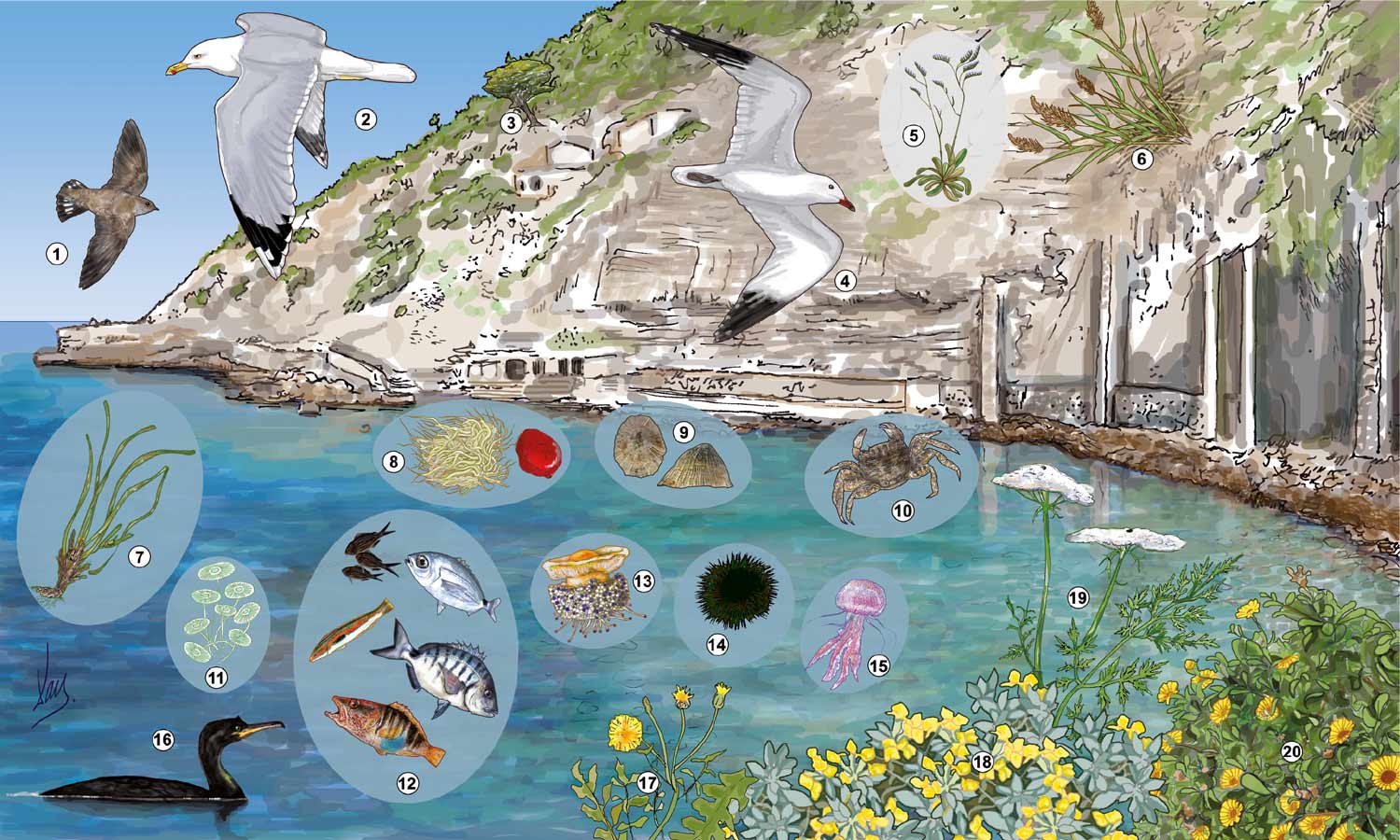
1. Ptyonoprogne rupestris
Eurasian Crag Martin. A swallow adapted to cliff habitats. It is present throughout the year.
2. Larus michahellis
Yellow-legged Gull. The most common gull species. Although it is a seabird, it can also be found in a variety of other habitats.
3. Pinus halepensis
Aleppo Pine. A typical Mediterranean tree. It forms pine forests, which play an important role in soil protection.
4. Ichthyaetus audouinii
Audouin’s Gull. A gull endemic to the Mediterranean. It is considered vulnerable due to human pressure. Its distinctive coral-red bill is a key identifying feature.
5. Limonium spp.
Sea-lavender or Statice. There are around 30 species in the Balearic Islands, many of which are difficult to distinguish. They grow close to the coast. Their flowers are very small.
6. Arundo donax
Giant Reed. Originally from Asia, it grows in wet areas and along streambeds. Traditionally, it has been used in agriculture and construction.
7. Posidonia oceanica
Neptune seagrass. A marine plant with a very slow growth rate that forms extensive meadows of great importance to the underwater ecosystem. Its remains accumulate on the shore, creating a natural barrier against waves and coastal erosion.
8. Anemonia viridis / Actinia equina
Beadlet anemone and Snakelocks anemone. These are the two easiest sea anemone species to observe. They live in shallow waters.
9. Patella caerulea / Patella rustica
Limpets. The two most common species can be distinguished by their shape: one is flat and the other cone-shaped. They live on shallow rocky substrates, moving slowly and clinging firmly to the rock when threatened.
10. Pachygrapsus marmoratus
Runner Crab. It lives on rocky shores, quickly hiding in crevices and holes when disturbed. It is omnivorous.
11. Acetabularia acetabulum
Mermaid’s Wineglass. An organism consisting of a single cell, with a long, slender stalk topped by a disc that appears in spring and summer for reproduction. It lives in shallow rocky habitats.
12. Chromis chromis / Oblada melanura / Diplodus sargus / Coris julis / Serranus scriba
Rock Fish. This term includes many species that inhabit rocky seabeds and Posidonia meadows. Notable examples are the damselfish, saddled seabream, white seabream, rainbow wrasse and painted comber.
13. Cotylorhiza tuberculata
Fried Egg Jellyfish. Easily distinguished from other jellyfish species. It is common in late summer and autumn, when marine currents bring it close to the shore. It is often accompanied by juvenile fish.
14. Arbacia lixula / Paracentrotus lividus
Sea Urchins. Two species of sea urchins can be found living on submerged rocks. They feed on algae.
15. Pelagia noctiluca
Mauve Stinger Jellyfish. The most common jellyfish species. It can form large blooms that prevent people from swimming. Its tentacles contain highly stinging cells.
16. Gulosus aristotelis
European Shag. A characteristic seabird that catches fish by diving underwater. It flies low over the sea surface and nests on cliffs.
17. Sonchus tenerrimus var. pectinatus
Slender Sow-thistle. A coastal variety that grows on rocky shores and cliffs. It differs somewhat from the sow-thistles commonly found along roadsides and terrace walls.
18. Lotus cytisoides
Grey Bird’s-foot Trefoil. Its branches and stems are covered with grey hairs. Its bright yellow flowers stand out during spring. It is mainly found along the coast.
19. Daucus carota subsp. commutatus
Wild Carrot. A coastal subspecies adapted to maritime conditions. Its tiny flowers are clustered together, forming a white platform that can be seen from a distance.
20. Pallenis maritima
Mediterranean Beach Daisy. A woody-based plant forming small bushes with yellow daisy-like flowers. It grows on rocky coasts.
Port des Canonge
This rocky coastal inlet is formed by some of the oldest materials in Mallorca, dating from the Permian and Lower Triassic periods (around 250 million years ago). Its reddish colour is due to the presence of iron minerals. It is popularly known as “pedra esmoladora” (“sharpening stone”). The surrounding vegetation mainly consists of Aleppo pine, mastic shrub, narrow-leaved mock privet and Mauritanian grass. The seabed is rocky, with rounded pebbles.
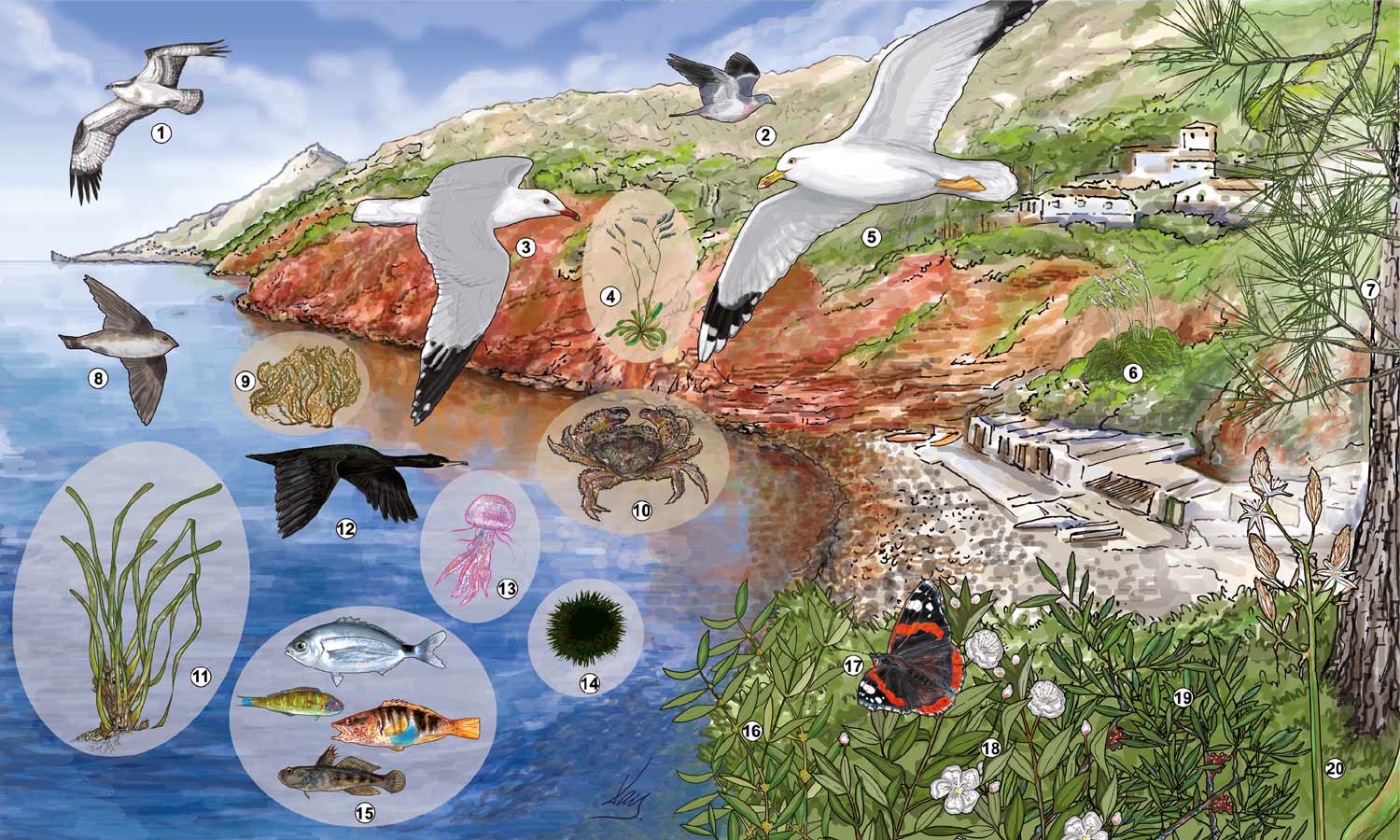
1. Pandion haliaetus
Osprey. A diurnal bird of prey that feeds on fish, which it catches by diving into the water and then carrying them in flight with its talons. It breeds on coastal cliffs.
2. Columba palumbus
Common Woodpigeon. A large wild pigeon that has experienced a notable increase in population in recent years. It has a white patch on each side of the neck and its call is characteristic. It lives in a wide variety of habitats.
3. Ichthyaetus audouinii
Audouin’s Gull. A gull endemic to the Mediterranean. It is considered vulnerable due to human pressure. Its distinctive coral-red bill is a key identifying feature.
4. Limonium spp.
Sea-lavender or Statice. There are around 30 species in the Balearic Islands, many of which are difficult to distinguish. They grow close to the coast. Their flowers are very small.
5. Larus michahellis
Yellow-legged Gull. The most common gull species. Although it is a seabird, it can also be found in a variety of other habitats.
6. Ampelodesmos mauritanicus
Mauritanian Grass. A large grass with very long, narrow leaves that forms the communities known locally as carritxeres. It grows after forest fires and protects the soil from erosion. Its flowering stems can exceed one metre in height.
7. Pinus halepensis
Aleppo Pine. A typical Mediterranean tree. It forms pine forests, which play an important role in soil protection.
8. Ptyonoprogne rupestris
Eurasian Crag Martin. A swallow adapted to cliff habitats. It is present throughout the year.
9. Cystoseira amentacea (= Ericarea amentacea)
Rainbow Wrack. A brown alga that grows on rocks in shallow water. It forms a habitat that provides shelter for different species.
10. Eriphia verrucosa
Warty Crab. A robust and powerful crab, with prominent claws covered in tubercles. It inhabits holes and crevices in rocky substrates. It is a voracious predator.
11. Posidonia oceanica
Neptune seagrass. A marine plant with a very slow growth rate that forms extensive meadows of great importance to the underwater ecosystem. Its remains accumulate on the shore, creating a natural barrier against waves and coastal erosion.
12. Gulosus aristotelis
European Shag. A characteristic seabird that catches fish by diving underwater. It flies low over the sea surface and nests on cliffs.
13. Pelagia noctiluca
Mauve Stinger Jellyfish. The most common jellyfish species. It can form large blooms that prevent people from swimming. Its tentacles contain highly stinging cells.
14. Arbacia lixula / Paracentrotus lividus
Sea Urchins. Two species of sea urchins can be found living on submerged rocks. They feed on algae.
15. Oblada melanura / Thalassoma pavo / Serranus scriba / Gobius niger
Rock Fish. This term includes many species that live on rocky seabeds and in Posidonia meadows. Notable examples are the saddled seabream, ornate wrasse, painted comber and black goby.
16. Phillyrea angustifolia
Narrow-leaved Mock Privet. A shrub with narrow leaves. The flowers are small and whitish, grouped at the base of the leaves. The fruits resemble small olives.
17. Vanessa atalanta
Red Admiral. An unmistakable butterfly with very visible red bands on a black background. It can be found throughout most of the year. There is a migratory generation that arrives in autumn. The caterpillar feeds on nettles.
18. Myrtus communis
Myrtle. A shrub with green, glossy leaves arranged in pairs. It gives off a characteristic aroma. White flowers appear in early summer. The purple fruits are edible.
19. Pistacia lentiscus
Mastic Tree. A shrub that forms dense vegetation masses which are very important as shelter for animal species. It is found in different habitats. The leaves are compound. It gives off a resinous scent. The fruits are small, round and red.
20. Asphodelus ramosus
Branched Asphodel. It grows in all types of terrain, especially Mediterranean scrubland, roadsides and woodland. The leaves are long and flat. At the beginning of spring it produces a long, thick stem with flowers at the upper part.